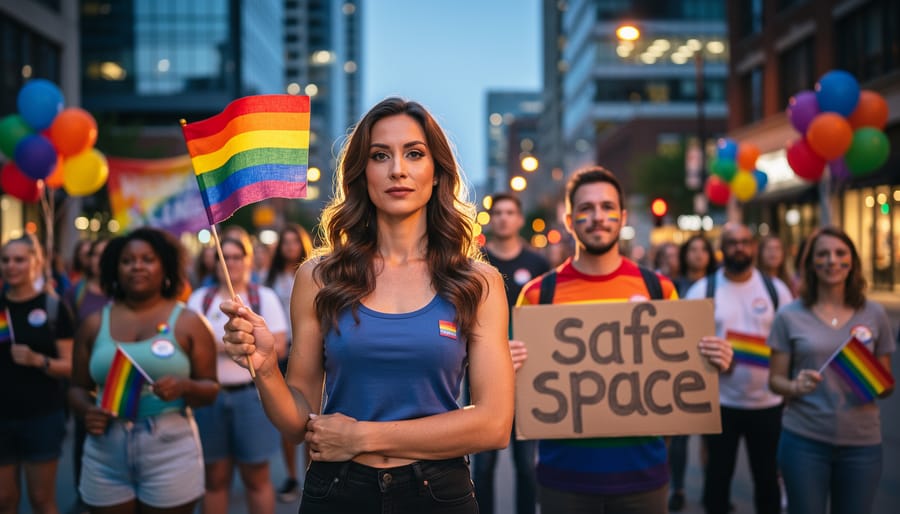
Pride V represents a powerful evolution in how LGBTQ+ communities celebrate visibility, resilience, and collective strength in 2026. The concept emerged from grassroots organizing within queer communities, particularly those facing intersecting forms of marginalization, as a framework for understanding Pride through five interconnected pillars: Visibility, Voice, Vitality, Victory, and Vigilance.
Unlike traditional Pride celebrations that center primarily on public parades and festivities, Pride V acknowledges the full spectrum of what liberation requires. For many in our community, particularly trans individuals, refugees, and those navigating complex immigration systems, Pride isn’t just about celebration. It’s about survival, advocacy, and creating pathways to safety.
Maria Santos, a trans woman who fled violence in her home country, describes her first Pride V event in Toronto: “I thought Pride was only for people who had already found their freedom. But Pride V showed me that fighting for how to find safety is itself an act of pride.” Her words capture the essence of this movement, which refuses to separate joy from justice.
The framework gained momentum in 2024 when community organizers across Canadian cities noticed a gap. Traditional Pride events sometimes overlooked those still fighting for basic rights: asylum seekers waiting for hearings, undocumented queer people afraid to be visible, and youth in hostile environments. Pride V bridges that gap by acknowledging that true Pride requires both celebration and sustained action.
Dr. James Chen, a policy researcher specializing in LGBTQ+ rights, explains: “Pride V isn’t replacing traditional Pride. It’s deepening our understanding of what Pride means when you’re still fighting for recognition, documentation, or physical safety.”
As we move through 2026, Pride V has become a rallying framework for those who understand that visibility without protection is incomplete, that voice without action rings hollow, and that celebration must include everyone, especially those whose Pride looks more like defiance than a parade float. This is the story of how our community expanded what Pride means.
The Birth of Pride V: How 2023 Changed Everything
The spring of 2023 arrived with a palpable sense of tension in Canada’s LGBTQ+ community. After years of pandemic-disrupted celebrations and a rising tide of anti-LGBTQ+ sentiment across North America, Pride organizers found themselves at a crossroads. The traditional parade-and-party model felt increasingly inadequate for addressing the complex challenges facing the community, from legislative rollbacks threatening trans rights to the unique vulnerabilities of LGBTQ+ refugees seeking safety in Canada.
In Vancouver, a group of organizers gathered in May 2023 for what they thought would be a routine planning session. Instead, it became a reckoning. Community members voiced frustration that Pride had become too commercialized, too focused on celebration without substance, and too exclusive of marginalized voices within the LGBTQ+ spectrum. Trans youth organizers pointed out that their needs were invisible. Two-Spirit community members questioned whether Pride truly honored Indigenous LGBTQ+ leadership. Newcomers from countries where homosexuality remained criminalized shared that they felt like spectators rather than participants.
We realized we weren’t just planning another party, we needed to reimagine what Pride could be when it actively centered every member of our community, not just the loudest or most visible.
This sentiment echoed across Canadian cities that summer. In Toronto, Montreal, and Edmonton, similar conversations erupted. Organizers began meeting virtually, sharing their frustrations and brainstorming solutions. By July 2023, a coalition had formed to develop what would become the Pride V framework.
The breakthrough came from listening sessions held during Pride celebrations that year. Rather than dictating what the community needed, organizers asked. They heard from a 19-year-old trans woman in Winnipeg who wanted Pride to offer more than rainbow merchandise. They listened to a gay Syrian refugee in Halifax who needed Pride to be a gateway to understanding his new country’s protections. They learned from a non-binary Indigenous youth in Calgary seeking authentic connection to both their queerness and cultural heritage.
These conversations revealed five recurring themes, vision, visibility, victory, voice, and values, that the community desperately wanted Pride to embody. By autumn 2023, the Pride V framework had been codified, tested, and adopted by organizations nationwide. What began as frustration transformed into a blueprint for celebration grounded in purpose, a shift that continues reshaping Canadian Pride events today.
The Five Pillars: Understanding Each V
Vision: Imagining Our Collective Future
Vision is the first V because it asks a fundamental question: what future do we want to create together? Rather than treating Pride as an annual celebration that ends when the parade finishes, this pillar pushes communities to define concrete, long-term goals for LGBTQ+ equality and inclusion.
Toronto’s Pride organization embraced this approach in 2024 by launching a five-year roadmap developed with input from over 2,000 community members. The plan set specific targets: increasing affordable housing for LGBTQ+ youth by 30%, establishing mental health services in three additional neighborhoods, and creating employment partnerships with 50 local businesses. Two years in, they’ve exceeded their housing goal and formed 38 partnerships.
Vancouver took a different approach, focusing on intergenerational dialogue. They organized monthly vision circles where elders, young activists, and everyone in between discussed what they wanted Pride to look like in 2030. These conversations surfaced priorities that traditional planning might have missed, like preserving LGBTQ+ archives and creating mentorship programs connecting seasoned advocates with newcomers to both the community and the country.
The vision pillar transforms Pride from a moment into a movement with direction. It challenges organizers and participants alike to answer: when we celebrate, what are we celebrating toward?
Visibility: Celebrating Every Shade of the Rainbow
Visibility under the Pride V framework goes far beyond simply showing up. It means creating intentional space for identities that mainstream Pride celebrations have historically overlooked or pushed to the margins.
When Edmonton Pride adopted this pillar in 2024, organizers restructured their parade lineup to feature Two-Spirit elders at the front, followed by transgender youth groups and organizations serving LGBTQ+ people experiencing homelessness. Attendance among Indigenous community members doubled that year.
Marcus Chen, a non-binary immigrant from Malaysia, recalls their first Toronto Pride after moving to Canada in 2025: “I saw people who looked like me leading workshops, not just attending them. There were panels in Mandarin about non-binary identity. I finally understood that my queerness didn’t have to fit into Western categories to be valid here.”
The visibility pillar challenges Pride organizers to ask tough questions. Whose stories dominate your promotional materials? Which community members feel safe enough to attend? Are bisexual and asexual voices heard, or drowned out by LG narratives?
Vancouver’s 2026 Pride featured a “Margins to Centre” stage exclusively for performers from underrepresented backgrounds. The result wasn’t just diversity, it was a fundamental shift in whose joy, whose creativity, and whose existence got celebrated first.
Victory: Acknowledging Progress While Pushing Forward
Victory celebrates how far Canada’s LGBTQ+ community has traveled while refusing to mistake progress for arrival. This pillar honors genuine achievements, marriage equality since 2005, federal protections for gender identity and expression, conversion therapy bans, without pretending these wins solved everything.
At Montreal Pride 2024, organizers created a “Victory Wall” where attendees posted both triumphs and unfinished work. “I can finally sponsor my partner” appeared beside “My refugee claim took three years.” This juxtaposition captures Victory’s essence: acknowledging real change while staying honest about gaps.
For LGBTQ+ newcomers, Victory means recognizing Canada’s stronger legal protections compared to many countries of origin, yet understanding that systemic barriers remain. A trans woman from Uganda celebrated accessing gender-affirming healthcare in Toronto, then shared her struggle finding employment despite Canadian credentials.
Pride V’s Victory component pushes communities beyond annual celebration into year-round accountability. Vancouver’s 2025 Pride report measured not just parade attendance but tangible outcomes: LGBTQ+ youth homelessness rates, employment discrimination complaints resolved, accessible Pride programming offered. Victory tracks whether celebrations translate into material improvements for the most vulnerable community members, particularly those navigating immigration systems or facing multiple forms of marginalization.
Voice: Amplifying Diverse Stories
Voice represents the fourth pillar of Pride V, and it tackles a fundamental truth: Pride celebrations have historically amplified certain stories while others remained whispered at the margins. Since 2023, this pillar has pushed organizers to actively create platforms where community members who’ve long been silenced can speak their truth, not as token representatives, but as essential voices shaping our collective narrative.
The shift is concrete. Vancouver Pride 2024 introduced “Unheard Voices,” a series that featured LGBTQ+ immigrants sharing their journeys in their own languages, with live translation. Attendees heard a trans woman from Uganda describe fleeing violence and finding asylum for trans people in Canada, her words carrying weight that no statistics could match. Montreal’s Pride implemented open-mic sessions specifically for Two-Spirit community members, creating space for Indigenous LGBTQ+ people to connect cultural identity with queer experience.
This pillar recognizes that visibility without voice is performative. Edmonton Pride 2025 partnered with refugee organizations to train LGBTQ+ newcomers in digital storytelling, resulting in short films screened throughout Pride week. One Syrian refugee’s five-minute piece about rebuilding identity after displacement drew standing-room crowds. The Voice pillar insists that those who’ve fought hardest for their place in the rainbow deserve the microphone, not just a spot in the parade.

Values: Grounding Celebration in Principles
Values form the foundation that transforms Pride from a party into a movement. The final V in Pride V asks a critical question: what principles guide our celebrations and activism?
Pride V centers three non-negotiable values. Intersectionality acknowledges that LGBTQ+ people hold multiple identities, race, disability, class, immigration status, that shape distinct experiences. Vancouver Pride 2025 demonstrated this by programming events specifically for queer and trans people of colour, disabled community members, and low-income families, ensuring no one faced barriers to participation.
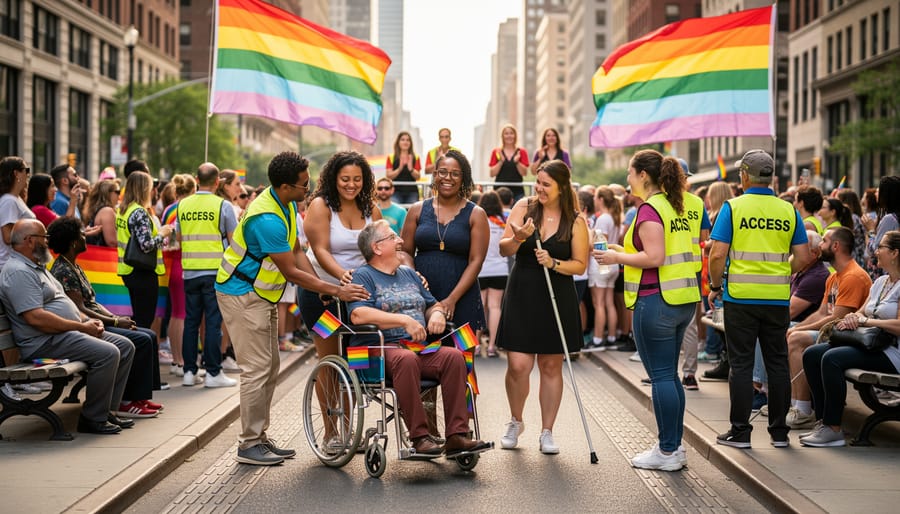
Accessibility extends beyond wheelchair ramps. It means ASL interpretation at all main events, sensory-friendly spaces for autistic attendees, sliding-scale fees, and materials in multiple languages. Toronto Pride 2026 introduced “quiet zones” at festival sites and offered free childcare, recognizing that accessibility looks different for everyone.
Community care shifts focus from corporate sponsorship to mutual support. Pride organizers now prioritize local LGBTQ+-owned businesses, create volunteer support systems, and build programming that strengthens year-round connections rather than one-week spectacles.
These values aren’t abstract ideals. They’re practical commitments that appear in budget decisions, volunteer training, and event design. When values lead, Pride becomes accountable to the communities it serves, not the institutions that want to profit from rainbow-washing.
Pride V in Action: Success Stories Across Canada
Since 2023, Pride organizations from coast to coast have transformed the Pride V framework from concept into lived reality, creating celebrations that center vision, visibility, victory, voice, and values in tangible ways.
In Vancouver, Pride Society organizers redesigned their 2024 festival around accessibility as a core Pride V principle. They created sensory-friendly zones with reduced noise and lighting for autistic community members, offered ASL interpretation at all main stage events, and partnered with local disability advocates to audit every venue. “We realized visibility meant nothing if entire segments of our community couldn’t physically access the celebration,” explains festival coordinator Maya Chen. The initiative increased participation by neurodivergent and disabled LGBTQ+ individuals by 40% compared to previous years.
Toronto’s 2025 Pride took the “voice” pillar seriously by launching the Community Storytelling Pavilion, where attendees could record and share three-minute personal narratives. Over 300 stories were collected during the festival week, with special emphasis on amplifying experiences from Black, Indigenous, and racialized queer and trans people. These recordings now form a permanent digital archive that educators and researchers access regularly. The pavilion also featured dedicated sessions for newcomers to Canada, connecting celebration with LGBTQ+ refugee support resources and creating space for immigrants to share how Pride in Canada compared to celebrations or persecution in their home countries.
Halifax demonstrated the “victory” component through its Justice & Joy programming, which paired celebration with concrete advocacy. Each day of Pride 2026 featured morning workshops on current policy issues, healthcare access for trans youth, conversion therapy enforcement, rural LGBTQ+ isolation, followed by afternoon celebration. Attendees who participated in advocacy sessions received pins reading “Celebrate Progress, Demand More,” embodying the Pride V balance between honoring gains and pushing forward.
Edmonton’s Indigenous Two-Spirit community reshaped their city’s 2024 Pride around the “vision” pillar by centering land acknowledgment and decolonization throughout the festival. They created the Two-Spirit Futures Forum where Indigenous LGBTQ+ youth articulated their dreams for community healing and cultural reclamation, directly influencing how the city allocates Pride funding.
Several smaller communities have adopted Pride V with remarkable innovation:
- Charlottetown developed a year-round Pride V community circle that meets monthly to sustain connections beyond June celebrations
- Saskatoon created a Pride V toolkit for rural Saskatchewan towns, helping smaller communities organize their first-ever Pride events with built-in frameworks for inclusion
- Thunder Bay launched a Pride V mentorship program pairing LGBTQ+ elders with youth to ensure intergenerational knowledge transfer and values continuity
- Regina established a Pride V fund specifically supporting newcomer-led LGBTQ+ initiatives, recognizing that immigrant voices needed dedicated resources to be heard
These examples represent just a fraction of Pride V’s influence. What unites them is the shift from Pride as a single weekend of celebration to Pride as an ongoing practice of community building grounded in shared principles.
Why Pride V Matters for LGBTQ+ Newcomers to Canada
When Mariana arrived in Canada from Brazil in 2024, she expected Pride to feel familiar, a joyous celebration she’d participated in back home. What she didn’t anticipate was how differently Canadian Pride events, shaped by the Pride V framework, would address the specific anxieties she carried as a newcomer. “In São Paulo, Pride was incredible but generic,” she explains. “Here, I saw immigration lawyers at Pride booths, multilingual resource guides, and workshops specifically for LGBTQ+ refugees. Someone actually asked about my journey and what I needed to feel safe.”
This shift reflects how Pride V fundamentally changed what newcomers encounter when they attend Pride events in Canada. The framework’s emphasis on Voice created intentional platforms for immigrant and refugee stories, replacing token representation with genuine community leadership. Organizations now routinely include newcomers on planning committees, ensuring Pride programming addresses practical realities like navigating healthcare systems, understanding legal protections, and accessing culturally-competent support services.
The Visibility pillar proved particularly transformative. Pride V pushed communities to recognize that many LGBTQ+ newcomers carry compounded invisibility, marginalized both as immigrants and as queer people. Events started featuring specific cultural celebrations, creating space for traditions and expressions that mainstream Pride had overlooked. A Punjabi drag show in Surrey, an Arabic-language legal clinic in Montreal, and Caribbean-focused social groups in Toronto emerged directly from Pride V’s commitment to seeing everyone.
Immigration advocate Dr. Patricia Chen notes that Pride V’s Values pillar addresses something critical: “Many LGBTQ+ refugees experience Pride events as overwhelming or even triggering after fleeing persecution. When Pride organizers center accessibility and trauma-informed practices, which Pride V demands, they create entry points for people who desperately need community but can’t handle massive crowds or police presence.” This includes quiet spaces, interpretation services, and direct connections to resources like trans asylum safety information.
The Victory component helps newcomers understand Canada’s legal landscape while acknowledging ongoing challenges they face, from credential recognition to family sponsorship barriers. Pride V transformed Pride from a celebration newcomers observed into a movement actively invested in their full belonging and safety.
Three years after its emergence, Pride V has fundamentally shifted what Pride means in Canada. What began as a framework during 2023 celebrations has evolved into the foundation for how communities organize, advocate, and celebrate throughout the year. Cities from coast to coast now build their programming around vision, visibility, victory, voice, and values, not as buzzwords, but as practical tools for creating Pride events that serve everyone, especially those most vulnerable.
The impact reaches beyond parades and festivals. Community organizations use Pride V principles to shape policy recommendations, design support services, and welcome LGBTQ+ newcomers. Whether someone is seeking asylum in Canada or a longtime resident pushing for local change, this framework offers shared language and shared purpose.
Your role in Pride V doesn’t require organizing a massive event. It starts with asking: What vision do you hold for your community? Whose visibility are you championing? Which victories deserve recognition, and what voices need amplification? What values guide your actions?
These questions transform Pride from something that happens one month per year into a continuous practice of building the inclusive Canada we want to see. The framework exists because community members like you demanded better. Keep that momentum alive. Bring Pride V into your workplace, your neighbourhood, your conversations. The next chapter of this movement depends on all of us showing up with intention and purpose.






+ There are no comments
Add yours